
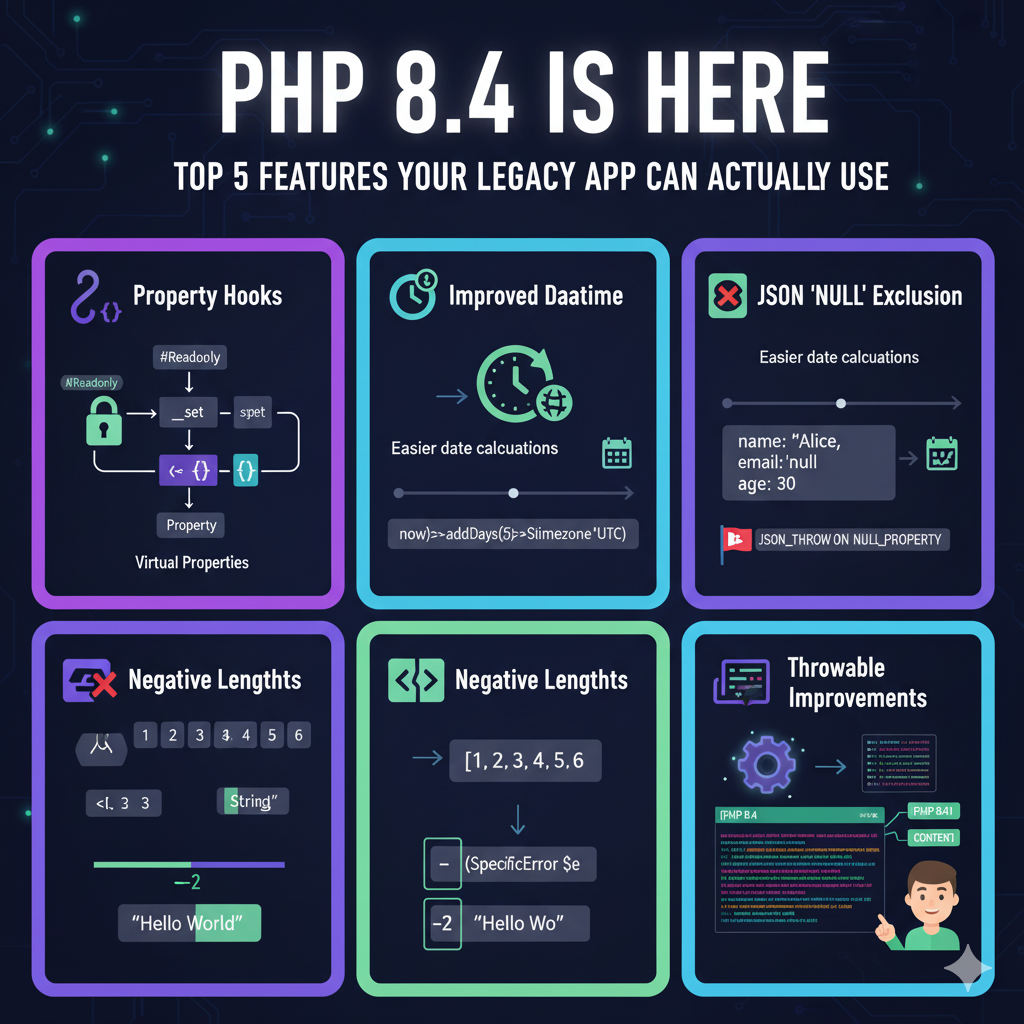
The PHP ecosystem is constantly evolving, and with each new version, developers get more powerful tools. While a complete rewrite to take advantage of every new feature might be a dream for many maintaining legacy applications, PHP 8.4 brings several key improvements that you can incrementally adopt to make your existing codebase more robust, readable, and efficient.
You don’t need to overhaul your entire application to benefit. Here are five top features in PHP 8.4 that are genuinely useful for maintenance and can be integrated with minimal disruption.
1. Property Hooks (#[Readonly] with __set / __get Improvements)
One of the biggest pain points in older PHP applications is inconsistent data validation and access to object properties. PHP 8.4 significantly enhances property management with property hooks, building upon the #[Readonly] attribute introduced in PHP 8.1.
While #[Readonly] makes a property immutable after initialization, the new changes allow you to define __set and __get methods even for readonly properties. This might sound counterintuitive, but it opens up powerful possibilities:
- Controlled Access for Readonly Properties: You can now intercept attempts to read or write a
#[Readonly]property, even if the direct assignment is blocked. This is fantastic for debugging, logging, or implementing more complex virtual property logic. - Virtual Properties: You can create “virtual” properties that don’t have a direct backing field but are computed on the fly or fetched from an external source (like a database or an API).
- Centralized Validation/Transformation: Use
__setto sanitize or validate data before it’s actually assigned to a non-readonly property, ensuring consistency across your application without scattering validation logic everywhere.
Example (simplified):
PHP
class User
{
    private string $firstName;
    private string $lastName;

    public function __set(string $name, mixed $value): void
    {
        if ($name === 'fullName') {
            [$this->firstName, $this->lastName] = explode(' ', $value, 2);
        } else {
            // Default behavior for other properties
            $this->$name = $value;
        }
    }

    public function __get(string $name): mixed
    {
        if ($name === 'fullName') {
            return $this->firstName . ' ' . $this->lastName;
        }
        // Default behavior for other properties
        return $this->$name;
    }

    public function getFirstName(): string { return $this->firstName; }
    public function getLastName(): string { return $this->lastName; }
}

$user = new User();
$user->fullName = 'John Doe'; // Using the __set hook
echo $user->getFirstName(); // Outputs: John
echo $user->fullName;     // Using the __get hook, outputs: John Doe
This feature allows you to introduce more sophisticated data handling without extensive refactoring of every single class.
2. Improved DateTime Object Operations
Working with dates and times in PHP can be notoriously tricky, especially when dealing with timezones or complex calculations. PHP 8.4 continues to refine the DateTime and DateTimeImmutable objects, making them even more user-friendly and reliable. While specific new methods might vary, common improvements focus on:
- More Intuitive Calculations: Expect more direct and chainable methods for adding, subtracting, or comparing dates without converting to timestamps or using cumbersome
DateIntervalobjects for simple tasks. - Enhanced Timezone Handling: Better default behaviors or clearer ways to specify and switch timezones, reducing common bugs related to daylight saving or misinterpretations of UTC vs. local time.
- Factory Methods: Simpler ways to create
DateTimeobjects from various inputs, reducing boilerplate code and potential parsing errors.
These improvements mean less error-prone date code, which is invaluable for any system that deals with logging, scheduling, or reporting.
3. New json_encode() Flag for NULL Property Exclusion
When dealing with APIs or storing configuration, you often want to exclude properties that are null from your JSON output to save space or conform to API specifications. Previously, this required manual filtering of arrays before encoding. PHP 8.4 introduces a new json_encode() flag that handles this automatically: JSON_THROW_ON_NULL_PROPERTY.
This flag, used in conjunction with JSON_UNESCAPED_SLASHES or JSON_PRETTY_PRINT, streamlines your JSON serialization logic.
Example:
PHP
$data = [
    'name' => 'Alice',
    'email' => null,
    'age' => 30,
    'city' => 'New York',
    'preferences' => ['theme' => 'dark', 'notifications' => null]
];

// PHP < 8.4 (manual filtering needed for 'null' exclusion)
// $filteredData = array_filter($data, fn($value) => $value !== null);
// echo json_encode($filteredData, JSON_PRETTY_PRINT);

// PHP 8.4 (with the new flag)
echo json_encode($data, JSON_PRETTY_PRINT | JSON_UNESCAPED_SLASHES | JSON_THROW_ON_NULL_PROPERTY);
This will produce JSON without the email and preferences.notifications fields, making your output cleaner with less code.
4. Array and String Functions with Negative Length
Manipulating arrays and strings with precise offsets and lengths is a common task. PHP 8.4 introduces support for negative lengths in several core array and string functions (e.g., array_slice, substr). This mirrors the existing behavior of negative offsets, allowing for more intuitive “from the end” slicing.
Example:
PHP
$array = [1, 2, 3, 4, 5, 6];
$string = "Hello World";

// Get elements from the beginning, excluding the last 2
// PHP < 8.4: array_slice($array, 0, count($array) - 2);
// PHP 8.4:
print_r(array_slice($array, 0, -2)); // [1, 2, 3, 4]

// Get substring from the beginning, excluding the last 3 characters
// PHP < 8.4: substr($string, 0, strlen($string) - 3);
// PHP 8.4:
echo substr($string, 0, -3); // "Hello Wo"
This seemingly small change reduces the need for count() or strlen() calls, making your array and string manipulation code more concise and readable.
5. Easier Custom Error Handling with Throwable Improvements
While not a direct feature for day-to-day coding, PHP 8.4 brings refinements to the Throwable interface and error handling mechanisms. This is crucial for maintenance because it allows for more robust, centralized error logging and reporting.
Improvements often include:
- More Granular Error Types: Potentially new or more specific
Throwableinterfaces or base classes that allow you to catch and handle different types of internal PHP errors with greater precision. - Richer Context in Error Objects:
Throwableobjects might carry more metadata, such as the exact PHP version, specific configuration flags, or even details about the execution environment that are invaluable when debugging production issues. - Improved Stack Traces: More informative stack traces, especially for internal PHP errors or during fatal error recovery, which makes pinpointing the root cause much faster.
For a maintenance team, being able to reliably catch, log, and report on various types of errors is paramount. These improvements mean less time sifting through vague logs and more time fixing actual problems.
Conclusion
Upgrading a large, mature PHP application can be daunting, but PHP 8.4 offers pragmatic features that can be integrated incrementally. By focusing on areas like property handling, improved date operations, streamlined JSON output, more flexible array/string functions, and robust error handling, you can begin to modernize your codebase and enjoy a more productive development experience without committing to a full rewrite.
Start exploring these features and see how they can benefit your current projects!